Why Is Your Heating Bill Climbing When Nothing Else Changed?
You didn’t turn the thermostat up. You didn’t add a room. Your family didn’t grow. But the gas bill for January came in higher than last year’s, and the year before that.
Sound familiar?
It’s frustrating when you’re paying more for the same warm house. And if your furnace is 10 years old or older, there’s a good chance the furnace itself is the reason. Older furnaces lose efficiency little by little. You don’t notice it day to day. You notice it on the bill.
Here’s the good news. Most of that lost efficiency can be won back with the right furnace maintenance. In this guide, you’ll learn why older furnaces burn more fuel, how to tell if yours is wasting money, which maintenance steps matter most, and when it’s time to stop repairing and start planning for a new system.
What Happens Inside a Furnace After Year 10
Think of your furnace like a pickup truck. At 30,000 miles, it runs fine with almost no attention. At 150,000 miles, it still runs. But skip an oil change or ignore a squeak, and costs pile up fast.
Furnaces work the same way. Around the 10-year mark, a few things start to happen at once.
The Small Parts Start to Wear Out
Your furnace has a blower motor, an inducer motor, a flame sensor, an igniter, and a set of safety switches. Each one wears down with every heating cycle. A furnace in south central Kansas or north central Oklahoma might run thousands of cycles every winter.
A worn blower motor draws more electricity to move the same amount of air. A dirty flame sensor can make the furnace shut off and restart over and over. That stop-and-start pattern is called short cycling, and it’s one of the biggest hidden energy wasters we see.
Dust and Grime Build Up Where You Can’t See
Here’s the thing about our part of the country. Between wheat harvest dust, red dirt, cottonwood fluff, and wind that never seems to quit, furnaces here collect grime faster than furnaces in a lot of other places.
That buildup coats the blower wheel. It clogs the filter. It settles on the burners. Every layer makes your furnace work harder to push heat through your home. And a furnace working harder is a furnace burning more gas.
Factory Warranties Usually Run Out
Many furnace parts warranties end somewhere around the 10-year point. That doesn’t mean your furnace is done. It does mean every repair now comes out of your pocket. So catching small problems early matters more than ever.
How to Tell If Your Furnace Is Wasting Money
You don’t need special tools to start investigating. You just need your old utility bills and a few minutes.
Try the “Same Month, Different Year” Test
Pull out your gas bills for the same month over the last two or three winters. Don’t just look at the dollar amount. Gas prices change, so the dollar total can fool you. Instead, find the actual usage number. On most bills, that’s listed in therms or CCF.
Now compare. Was this January colder than last January? If the weather was about the same and your usage jumped 10% or more, your furnace is likely losing efficiency. This simple check is one most homeowners never think to do. But it’s the clearest signal you’ve got.
Listen and Look for the Warning Signs
Your furnace also talks to you. You just have to know the language.
Some rooms feel colder than others, even with the vents open. The furnace runs for a few minutes, shuts off, and starts again too soon. You hear new sounds like rattling, squealing, or a loud boom when the burners light. The flame looks yellow or flickers instead of burning a steady blue. Your house seems dustier than it used to be.
Any one of these is worth a closer look. Two or more? It’s time to call a pro.
The Furnace Maintenance Steps That Actually Lower Your Bills
Look, not every maintenance step gives you the same payoff. Some save real money. Others mostly protect your safety. Both matters, but it helps to know which is which.
The table below breaks down the most important furnace maintenance tasks for older furnaces, what each one does, and who should handle it.
| Maintenance Task | Why It Matters for a 10+ Year Old Furnace | Effect on Energy Bills | Who Should Do It |
|---|---|---|---|
| Replace the air filter | A clogged filter chokes airflow and overworks the blower | High | Homeowner, every 1–3 months |
| Clean the blower wheel | Caked-on dust makes the motor spin harder for less air | High | Licensed technician |
| Clean and test the flame sensor | A dirty sensor causes short cycling and wasted gas | High | Licensed technician |
| Inspect and adjust burners | Dirty or misaligned burners waste fuel and burn unevenly | Medium to High | Licensed technician |
| Check gas pressure | Wrong pressure lowers efficiency and stresses parts | Medium | Licensed technician |
| Test motors and capacitors | Weak parts draw extra power and fail without warning | Medium | Licensed technician |
| Inspect the heat exchanger | Cracks can leak carbon monoxide into your home | Safety first | Licensed technician |
| Check the venting and flue | Blocked vents create safety and performance problems | Safety first | Licensed technician |
| Calibrate the thermostat | A thermostat that reads wrong runs the furnace too long | Medium | Technician or homeowner |
The Filter: Your Easiest Win
Let’s start with the one thing you can do yourself tonight. Check your filter.
A standard 1-inch filter should be changed every one to three months during heating season. In dusty months, or if you have pets, lean toward every month. A dirty filter is the single most common reason we find older furnaces struggling. And it costs just a few dollars to fix. Not sure which filter fits your system? Our guide to choosing the right HVAC air filters can help.
The exception is a thick media filter, like a 4- or 5-inch filter cabinet. Those can often last six months or more. When in doubt, pull it out and hold it up to the light. If you can’t see light through it, swap it.
The Professional Tune-Up: Where the Real Savings Hide
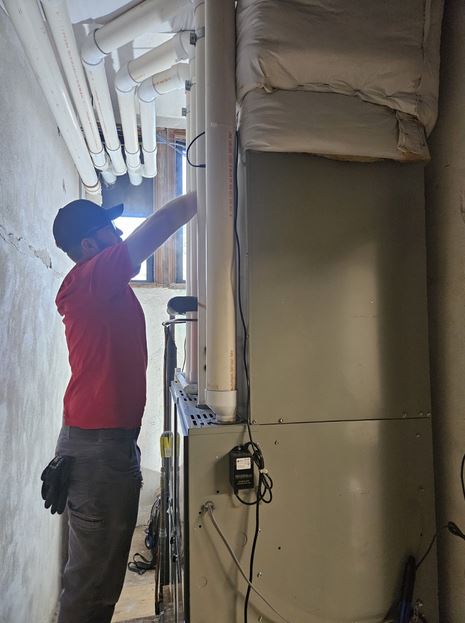
But here’s what matters most. The biggest efficiency gains come from steps you can’t safely do yourself. Cleaning the blower wheel, testing the flame sensor, setting gas pressure, and checking the heat exchanger all take training and the right tools.
A professional heating maintenance visit covers all of these at once. For an older furnace, that yearly visit often pays for itself in lower bills and fewer surprise breakdowns.
The Safety Check You Can’t Afford to Skip
Let’s slow down for a second, because this part is serious.
Older furnaces have a higher risk of a cracked heat exchanger. The heat exchanger is the metal chamber that keeps the burning gas separate from the air you breathe. After years of heating up and cooling down, the metal can crack. A cracked heat exchanger can let carbon monoxide into your home.
You can’t see it, smell it, or taste it. That’s why a trained technician needs to inspect it every year. Please also make sure you have working carbon monoxide detectors on every level of your home, especially near bedrooms.
If you ever have headaches, dizziness, or nausea that get better when you leave the house, get everyone outside and call for help right away.
When to Repair and When to Replace
At some point, every furnace owner faces the big question. Do I keep fixing this thing, or do I replace it?
You might feel overwhelmed by that choice. Nobody wants to spend thousands on a new system too early. But nobody wants to pour money into a furnace that’s about to quit, either.
A Simple Rule of Thumb
Many HVAC pros use what’s called the $5,000 rule. Multiply the age of your furnace by the cost of the repair. If the number is over $5,000, replacement usually makes more financial sense.
So a $300 repair on a 12-year-old furnace equals $3,600. Repair it. But a $500 repair on a 15-year-old furnace equals $7,500. It’s time to start getting quotes.
This rule isn’t perfect. It doesn’t account for how much your bills have climbed or how efficient a new furnace would be. But it’s a solid place to start the conversation.
What Efficiency Upgrades Really Look Like
Many furnaces installed 15 to 20 years ago were rated around 80% efficient. That means about 80 cents of every fuel dollar heats your home. The rest goes up the vent. And as those older furnaces age, the real-world number often slips lower.
Today’s high-efficiency gas furnaces can reach 95% or higher. For a household with high winter bills, that difference adds up season after season.
Honest Advice Beats a Sales Pitch
Here’s how we handle it. At Waldorf Riley, our technicians show you the repair option before the replacement option. If a repair will buy you two or three more good seasons, we’ll tell you that straight. If your furnace is costing you more to keep than to replace, we’ll show you the numbers so you can decide.
When replacement does make sense, you can request a free installation quote and explore our furnace replacement options. We also offer financing options, including 0% interest for up to 72 months on select systems with approved credit.
Why Timing Your Furnace Maintenance Matters
Want to know the secret to avoiding a no-heat emergency? Schedule your tune-up before you need the heat.
Early fall is ideal. Technicians have more open schedules, and any problems get caught before the first hard freeze. Wait until January, and you’re competing with every neighbor whose furnace just quit.
That said, if you missed the fall window, don’t skip maintenance altogether. A mid-winter tune-up is still far better than none. And if something does go wrong, Waldorf Riley completes 95% of service requests the same day or next day, with a licensed journeyman on every call.
Make It Automatic
The easiest way to never forget furnace maintenance is to stop relying on your memory. A maintenance plan puts your heating and cooling tune-ups on a schedule, so the reminder comes to you. Ask about our Premier Maintenance Plan when you request service. It’s one less thing to keep track of, and that alone is a relief for a lot of busy homeowners.
Frequently Asked Questions
How often does an older furnace need professional maintenance?
Once a year is the standard, ideally in early fall. For furnaces 15 years or older, or homes in very dusty areas, some homeowners choose a second check mid-season. Older furnaces have more worn parts, so yearly visits catch small problems before they turn into expensive breakdowns or safety issues.
Can furnace maintenance really lower my energy bills?
Yes, especially on an older furnace. Cleaning the blower, fixing short cycling caused by a dirty flame sensor, and adjusting burners all help the furnace heat your home with less fuel. The best way to measure the result is to compare your gas usage in therms for the same month before and after the tune-up, adjusting for weather.
What does a furnace maintenance visit include?
A thorough visit includes checking the filter, cleaning the blower and burners, testing the flame sensor and igniter, measuring gas pressure, testing motors and safety controls, checking the venting, and inspecting the heat exchanger for cracks. You should get a clear report of what was found, plus honest repair options if anything needs attention. Learn more about our full heating repair services.
Is it worth maintaining a 20-year-old furnace?
Usually yes, at least for safety. Even if you plan to replace it soon, a yearly inspection checks for carbon monoxide risks and helps you avoid a mid-winter failure. A good technician will also tell you honestly how much life your furnace likely has left, so you can plan and budget for a replacement on your timeline instead of in an emergency.
Warm Home, Lower Bills, Fewer Surprises
Let’s bring it all together. Older furnaces lose efficiency slowly, which is why rising bills sneak up on you. Comparing your gas usage year over year is the clearest way to spot the problem. A clean filter is your easiest fix, but a professional tune-up is where the bigger savings and the critical safety checks happen. And when repairs start adding up, the $5,000 rule can help you decide what comes next.
You don’t have to figure this out alone. Waldorf Riley has been keeping homes warm across south central Kansas and north central Oklahoma since 1951. Owner Chad Leonard holds Master Mechanical and Master Plumber licenses in both Kansas and Oklahoma, and our crew gives you straight answers, not sales pressure. Curious what your neighbors say? Read our customer reviews or meet the owner.
Ready to get your furnace checked before the cold hits? Schedule your furnace maintenance online or call your nearest office: Arkansas City at (620) 442-5610, Wellington at (620) 326-7788, or Ponca City at (580) 762-2700. Seniors 65 and older and military members can also save 10% on labor. See all our current specials and discounts.